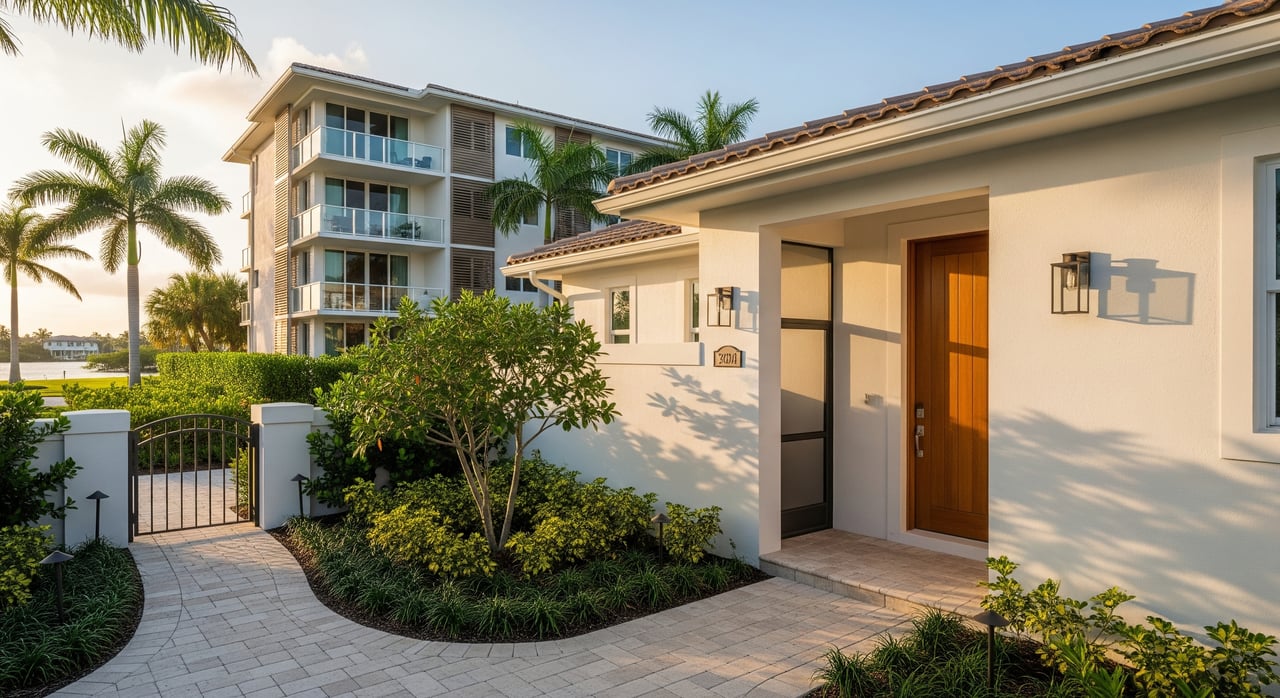
If you’re touring homes around Naples and keep hearing “coach home,” “carriage home,” and “condo,” you’re not alone. These places can look similar from the street, yet what you actually own, insure, and pay for each month can be very different. You want a place that fits your lifestyle and your budget without surprises.
This guide breaks down how coach homes and condos work in Collier County, how to tell them apart on a showing, and what documents to request before you make an offer. You’ll learn the key differences in ownership, insurance, fees, and storm risk so you can buy with confidence. Let’s dive in.
Quick definitions in Collier County
A coach home, sometimes called a carriage home, is typically a smaller dwelling with a private entry and an attached or tuck-under garage. It can be attached to other units or stand alone. Here’s the important part: a coach home may be legally organized as a condominium or as a fee-simple home within an HOA. The style does not determine ownership.
A condominium is a form of ownership where you own a defined unit (usually the interior space) and share an undivided interest in the common elements like exterior walls, roofs, hallways, elevators, grounds, and amenities. In Florida, condos are governed by Florida Statutes Chapter 718.
Ownership and title: what you actually buy
- Condo title: You receive a deed to a unit plus a shared interest in common elements. Your association is governed by Chapter 718.
- Fee-simple HOA title: You receive a deed to the lot and the structure. The association’s rules and disclosures follow Chapter 720.
Practical takeaway: A coach home could be either. Read the recorded declaration and plat to confirm the legal setup. Do not rely on the marketing name.
How they live and look
Coach homes often feel more like a house:
- Direct, private entry from a driveway or short exterior stair.
- One or two levels, commonly with living space over an attached garage.
- Small patio or balcony rather than a full yard.
Condos often live like a traditional apartment-style building:
- Entries through shared lobbies, corridors, and elevators.
- Assigned parking in a surface lot or garage, not always a deeded garage.
- Balconies are common; exteriors and roofs are typically common elements.
Visual cues are helpful but not definitive. Private exterior stairs and an attached garage suggest a coach home, while interior corridors and elevators suggest a condo building. Always verify with the deed and association documents.
Maintenance and insurance: who pays for what
Condominiums typically shift exterior responsibilities to the association. The association maintains the building exterior, roof, common systems, amenities, and grounds. Owners handle interiors and usually carry an HO-6 policy for contents, interior improvements, and loss assessment coverage. The master policy may define exactly what the association insures versus owners. Ask for the certificate of insurance and a plain-language summary of coverage.
Fee-simple coach homes within an HOA can work differently. You often maintain the entire structure and the roof, while the HOA handles landscaping, private roads, and shared amenities. Owners usually carry a standard HO-3 homeowner policy for the structure and contents. The HOA carries a policy for common areas.
In Collier County, wind, hurricane, and flood exposure can influence costs for both setups. Factor these insurance costs into your total monthly budget and confirm what the master policy covers after a storm.
Fees: what drives your monthly dues
Monthly dues vary widely, even between similar-looking properties. Key drivers include:
- Scope of responsibility: Structural and roof coverage, elevators, painting, and building insurance increase dues compared to “landscape-only” HOAs.
- Amenities and staffing: Gates, pools, fitness centers, security, and on-site managers add cost.
- Insurance: Coastal wind and flood exposure raise premiums for associations.
- Reserves: Well-funded reserves help avoid special assessments. Limited reserves may lead to spikes in dues.
- Size of association: Fewer units often mean higher per-unit costs.
- Master and sub-associations: Many Naples communities have a master association plus a neighborhood sub-association, so fees can stack.
Florida’s post-2021 environment brought more focus to structural safety and reserves. If you’re evaluating a multi-story building, ask whether the association has addressed any required inspections and long-term reserve planning. For statewide guidance on condominium oversight and inspections, review the Florida DBPR condominium resources.
Storm and flood realities in Collier County
Hurricanes and windstorms are part of life on Florida’s Gulf Coast. Many buildings use impact-rated windows, shutters, and reinforced roofs, but you still want to understand how damage would be handled under the association’s policy. Ask about deductibles and how they are apportioned.
Flood risk varies by neighborhood. Check FEMA’s Flood Insurance Rate Maps using the FEMA Flood Map Service Center. If available, request an elevation certificate to help insurance partners estimate your potential flood insurance premium.
How to verify the property type in Collier
The fastest way to confirm whether a property is a condo or a fee-simple coach home is to pull the recorded documents:
- Search the parcel and legal description on the Collier County Property Appraiser.
- Review the declaration, plat, and amendments in the Collier County Clerk of Courts Official Records.
On showings and during due diligence, ask:
- Is this recorded as a condominium unit or as a fee-simple lot/home? Can you share the declaration and plat?
- Who is responsible for the roof, exterior walls, and garage structure?
- What does the master insurance policy cover? Can I see the certificate of insurance?
- Are there any pending or recent special assessments?
- What are the rental and pet rules, and are there minimum occupancy requirements?
- Has the building had any structural inspections as required by state or local rules, if applicable?
Search smarter in the Naples area
When you search in the MLS or on portals, use targeted filters and keywords:
- Property type: Condo vs Townhouse vs Single-Family
- Features: attached garage, number of garage spaces, stories, elevator building
- Keywords: coach home, carriage home, carriage unit, coach villa, direct entry, private entry, tuck-under garage, fee-simple, condominium, zero lot line, no interior corridor, assigned parking, building entry
- Association name: helpful for researching master and sub-associations
Sample floor-plan snapshots
- Two-bedroom coach home, about 1,100–1,400 square feet: one-car garage at ground level, interior stairs up to open living and kitchen, two bedrooms and two baths, balcony off the living area.
- One-level carriage villa: single story above a tuck-under garage with open living and dining, primary suite, small front porch, and a private entry.
- Two-bedroom condo in a three-story building, about 1,200 square feet: entry through a lobby and central corridor, balcony off the living room, assigned surface parking space, building-maintained exterior.
- Ground-floor condo: direct exterior access to the unit, but the building exterior and roof are common elements under association control.
Buyer document checklist
Request these items as early as possible:
- Recorded declaration and plat
- Association bylaws, rules and regulations, and articles of incorporation
- Current budget, recent financial statements, and any audited reports
- Reserve study and the schedule of planned capital projects
- Certificate of insurance with a summary of coverage and deductibles
- Board and membership meeting minutes for the last 12 months
- Estoppel letter showing current assessments and owner dues
- Any engineering or structural inspection reports
- Rental policy, pet policy, and occupancy restrictions
- Litigation disclosures
Common misconceptions to avoid
- “Coach home equals fee-simple.” Not always. Many coach homes are legally condos. Always check recorded documents.
- “Association fees only cover landscaping and the pool.” In condos, dues often cover building insurance and exterior upkeep. In HOAs, coverage varies.
- “If I have a private garage, I insure less.” Your responsibility depends on the legal setup and the declaration. Confirm whether the garage is deeded to the unit or part of common elements.
Which is right for you?
Choose based on how you want to live and how you want to manage risk and costs.
- If you want a lock-and-leave lifestyle with the association handling exterior upkeep, a condo may fit your needs.
- If you prefer a more home-like feel with a private entry and garage, a coach home may be ideal. Just confirm whether it’s fee-simple or part of a condo association, since that changes maintenance and insurance.
If you want clear answers for a specific address, reach out. We’ll help you read the documents, understand the fees, and get realistic insurance estimates so you can move forward with confidence. Connect with Julieta Bruni for a friendly, expert consult in English or Spanish.
FAQs
What is a coach home in Collier County?
- A coach home is a dwelling with a private entry and usually an attached or tuck-under garage; it can be legally organized as a condominium or as a fee-simple home within an HOA, so always confirm with recorded documents.
How do Florida condo and HOA laws differ?
- Condominiums follow Florida Statutes Chapter 718, while HOAs follow Chapter 720; this affects governance, disclosures, maintenance responsibilities, and owner rights.
What insurance will I need for a condo vs a coach home?
- Condo owners usually carry an HO-6 for interior improvements and contents plus loss assessment coverage, while fee-simple coach home owners often carry an HO-3 that covers the structure and contents; verify the association’s master policy to know exactly where coverage starts and stops.
Why do two similar-looking Naples homes have very different dues?
- Dues reflect the scope of association responsibilities, amenities, insurance costs, reserves, building age, and whether there’s a master association in addition to a sub-association.
How can I check flood risk for a property in Collier?
- Use FEMA’s Flood Insurance Rate Maps, request any available elevation certificate, and speak with a local insurance professional to estimate flood premiums based on the exact location and building features.
Can a coach home be part of a condo association?
- Yes. The architectural style does not determine ownership; the recorded declaration and plat tell you whether it is a condo unit or a fee-simple lot within an HOA.